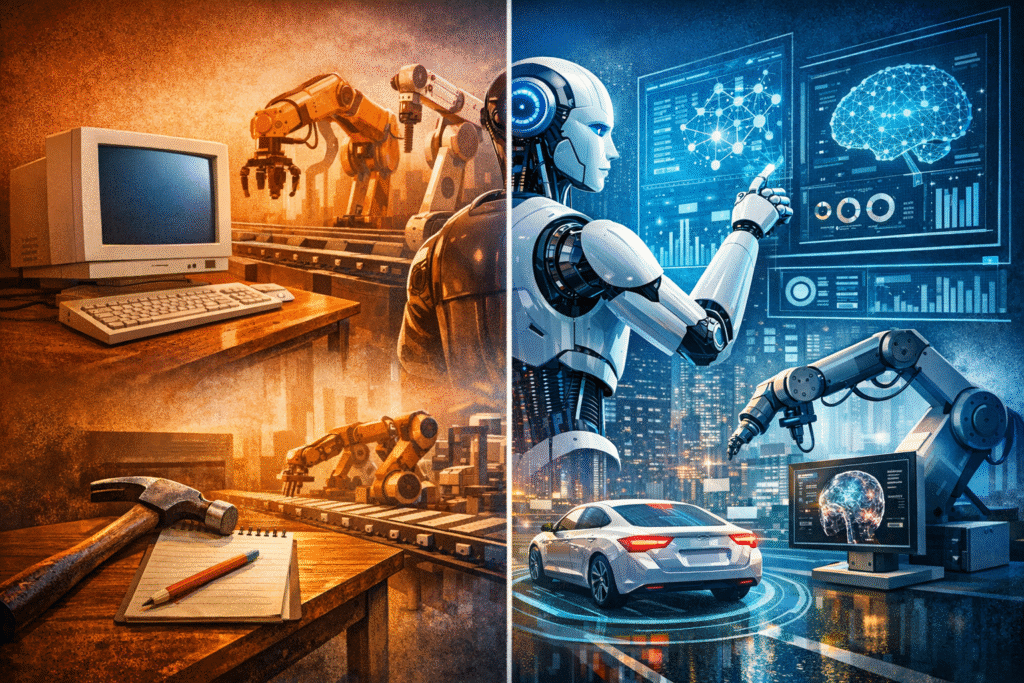
Technology has always shaped human civilization—from the discovery of fire to the invention of the printing press and the rise of the internet. Yet today, we are on the brink of a transformation that is fundamentally different: the age of Artificial Intelligence (AI). Unlike previous tools, AI doesn’t just extend human capabilities; it mimics intelligence itself, learns, adapts, and sometimes makes decisions. This raises a profound question: What will life look like when machines can think alongside us?
AI: From Automation to Augmentation
Traditional technology performs tasks based on fixed instructions. AI, however, can learn from data, recognize patterns, and improve over time. This ability transforms AI from a simple tool into a collaborator.
Examples:
-
Voice assistants like Siri or Google Assistant that understand context.
-
Self-driving cars capable of predicting pedestrian movement.
-
AI in hospitals detecting diseases early through image recognition.
Image suggestion:
-
Where: Right after this section.
-
Why: Show a visual comparison between traditional tools (like a hammer or computer) and AI systems (robotic arm, AI dashboard) to illustrate the shift from automation to intelligent augmentation.
This shift marks a transition from automation, which replaces human effort, to augmentation, which enhances it. AI doesn’t simply replace jobs; it enables humans to do them better.
How AI Will Transform Human Life
1. Work and Employment
AI’s impact on work is perhaps the most debated topic. While some jobs may disappear—especially repetitive, rule-based roles—new opportunities will emerge in areas requiring human creativity, empathy, and oversight.
Future career trends:
-
AI system managers: Professionals who oversee AI systems to ensure accuracy and fairness.
-
Ethics and policy experts: Specialists who ensure AI decisions respect societal values.
-
Creatives augmented by AI: Writers, designers, and innovators using AI to scale ideas faster.
Image suggestion:
-
Where: Beside this section.
-
Why: A graphic showing old vs. new job roles, with humans collaborating with AI in offices, creative spaces, and labs. It visually reinforces the idea that AI augments rather than replaces.
2. Healthcare and Longevity
AI is revolutionizing healthcare by enabling early diagnosis, precision treatments, and personalized medicine. Imagine a world where a simple scan predicts potential illnesses years before symptoms appear.
Examples:
-
AI algorithms detect cancer from radiology scans with higher accuracy than humans.
-
Robotic-assisted surgery allows precision beyond human hands.
-
AI-driven research identifies potential cures faster by analyzing millions of chemical compounds.
Image suggestion:
-
Where: Alongside the healthcare section.
-
Why: Show AI in a hospital setting, like a robot assisting surgery or a doctor analyzing AI-generated data, to make the concept tangible.
This could transform healthcare from reactive treatment to proactive prevention, extending human longevity and improving quality of life.
3. Education and Learning
Education is moving away from one-size-fits-all models. AI-powered platforms can tailor lessons to individual students, tracking their progress in real time and identifying strengths and weaknesses.
Benefits:
-
Personalized learning at scale.
-
Accessible education in remote areas.
-
Adaptive curriculums that evolve with student needs.
Image suggestion:
-
Where: Next to this section.
-
Why: Show a student using an AI learning platform with data analytics or personalized learning interface visible. It emphasizes education’s transformation.
Ethical Challenges and Responsibilities
As AI becomes powerful, it brings complex ethical dilemmas:
-
Accountability: Who is responsible for AI decisions?
-
Bias: How do we prevent discriminatory outcomes in AI algorithms?
-
Privacy: How do we protect personal data in a highly connected world?
Unchecked AI could widen inequality, reinforce bias, or be misused. Ethical AI development, regulatory frameworks, and transparency are essential to ensure technology benefits everyone.
Image suggestion:
-
Where: After ethical challenges section.
-
Why: Infographic showing AI ethics principles—fairness, accountability, transparency—to visually guide readers through complex ideas.
AI and Human Identity
AI forces us to confront a deeper question: What makes us human? Intelligence? Creativity? Empathy? Consciousness?
While AI can analyze vast datasets and even create content, it lacks moral intuition, emotional depth, and consciousness. The human role will increasingly shift to providing meaning, values, and direction, while AI handles complexity and scale.
Image suggestion:
-
Where: Beside this discussion.
-
Why: Artistic illustration of human brain vs. AI neural network or humans and robots working together—symbolizing collaboration rather than competition.
Looking Ahead: A Shared Future
The future of AI is not predetermined. It depends on the choices we make today as developers, policymakers, businesses, and individuals.
With responsible guidance, AI can:
-
Reduce global inequality
-
Accelerate scientific discovery
-
Solve complex challenges like climate change
The goal is not just smarter machines, but a smarter, more humane society where humans and AI work in harmony.
Conclusion
Artificial Intelligence is no longer just a technological advancement; it is shaping the next chapter of human civilization. While AI will undoubtedly change life as we know it, the ultimate outcome depends on how we integrate it into society.
The question is not whether AI will change the future—it already is. The real challenge is: Will we shape it responsibly, ethically, and wisely?
The future belongs to those who embrace AI as a partner, not a threat, in building a world that is both innovative and humane.


